
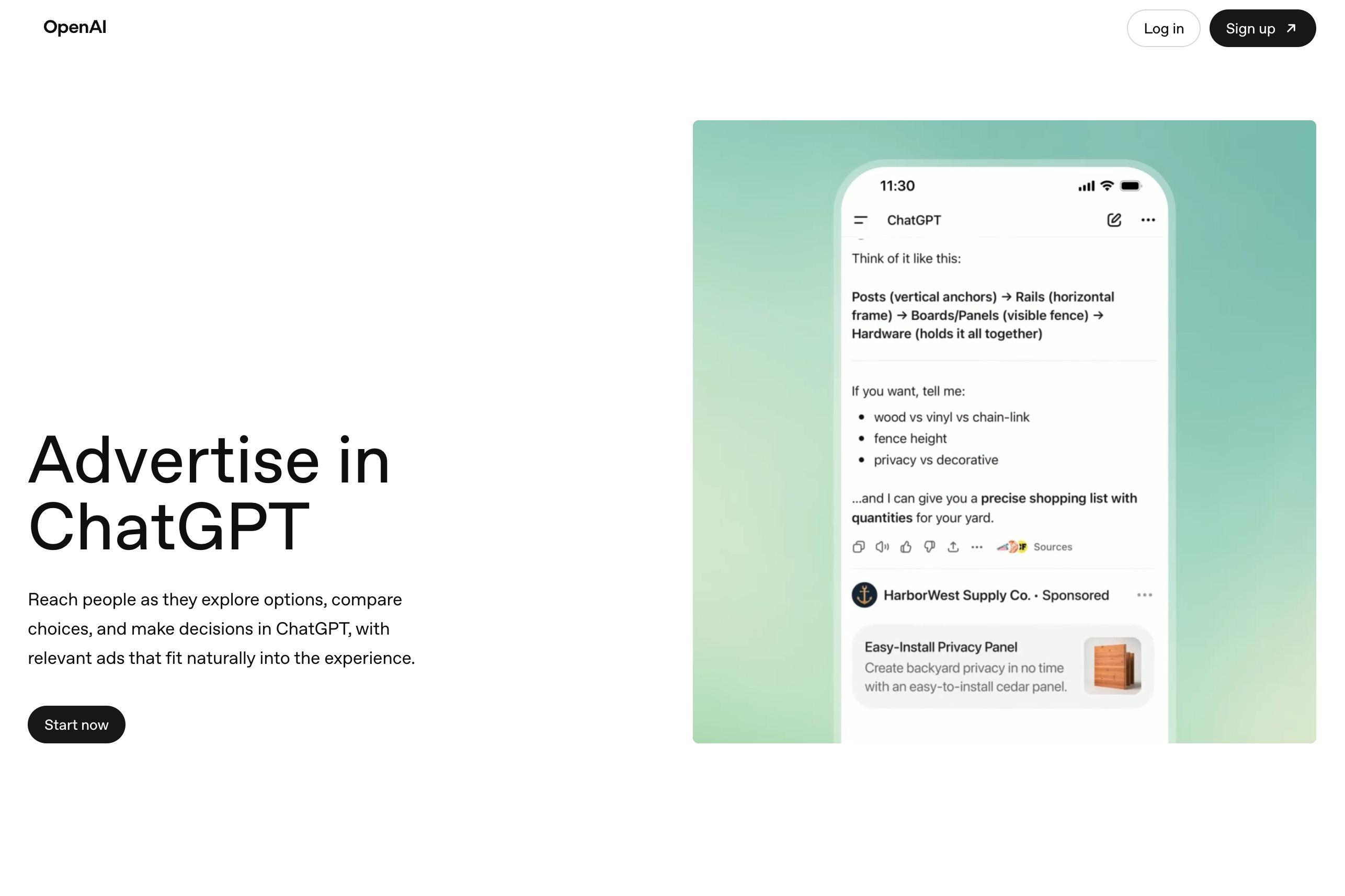
Update, 7 October 2026: ChatGPT Ads are now live in more than 60 countries, including Greece and the rest of the EU, and businesses there can buy through the self-serve Ads Manager. We have updated this article to reflect the rollout, the EU rules, and the new targeting and measurement features.
ChatGPT Ads are here. A few weeks ago, we launched our first ChatGPT Ads campaign for a client. The product was still early, the reporting was limited, and the way targeting works is very different from traditional search advertising.
The most important thing we learned is this: ChatGPT Ads are not Google Ads with AI. They are a new type of advertising environment. More contextual. More conversational. And, for now, much less transparent than the search platforms advertisers are used to.
Quick Summary
If you only have one minute, here is the short version:
- ChatGPT Ads are now available in Greece. Ads have served in Greece and the rest of the EU since 24 August 2026, and businesses can buy through the self-serve Ads Manager. In the EEA and Switzerland, ads are not personalized for now. They are matched to the current conversation, plus basic context such as general location and language.
- Ads appear to Free and Go users, not paid subscription users. That means a large audience, but not the full professional ChatGPT user base.
- There is still no search term report. Advertisers do not see the exact prompt or conversation that triggered an ad.
- Targeting is not keyword-based. It relies heavily on Context Hints: descriptive signals about the conversations, user needs, and buying situations where an ad group may be relevant.
- Testing matters. You need variations of angles, ad copy, titles, descriptions, and Context Hints to understand how the system matches ads to conversational intent.
What Are ChatGPT Ads?
ChatGPT Ads are ads shown inside the ChatGPT experience. According to OpenAI’s public documentation, ads may appear for users on Free and Go plans, while Plus, Pro, Business, Enterprise, and Edu accounts remain ad-free.
That distinction matters because ChatGPT is not a traditional search engine. People are not just typing keywords. They are asking questions, comparing options, describing problems, exploring decisions, and refining their thinking through conversation.
That changes how advertisers should think about targeting, creative, measurement, and campaign structure.
Instead of only asking “which keywords should we target?”, advertisers now need to ask:
- What conversations should our ad be relevant to?
- What type of user problem does our offer solve?
- What buying situation are we trying to match?
- What should the system understand about our audience, offer, and positioning?
This is where Context Hints become important.
1. ChatGPT Ads Are Rolling Out Fast
When we ran our first campaign, ChatGPT Ads were limited to a few markets. Greece, our main operating geography, was not one of them.
We expected more markets to follow. They followed faster than we expected.
Ads started serving in 31 European markets on 24 August 2026: all 27 EU member states, plus Iceland, Liechtenstein, Norway, and Switzerland. Greece is one of them. Since 31 August, businesses registered in those markets can open a self-serve Ads Manager account and buy directly, without going through OpenAI’s sales team or an agency.
Southeast Asia and Taiwan were added in late September. ChatGPT Ads now run in more than 60 countries.
There is one important difference for European advertisers. In the EEA and Switzerland, OpenAI does not offer personalized ads for now. Ads are matched to the current conversation and to basic context such as general location and language, not to past chats or memory. That makes Context Hints and creative even more important in Europe than in the US.
The question for most advertisers is no longer “when can we run this?” It is “should we test this now, and how?”
2. Ads Do Not Appear to All ChatGPT Users
This is one of the most important limitations.
ChatGPT Ads may appear to users on Free and Go plans. They do not appear to users on paid plans such as Plus, Pro, Business, Enterprise, or Edu.
So yes, the potential audience is large. But it is not the whole ChatGPT audience.
And for B2B advertisers, this matters. Many of the heaviest professional users are likely to be on paid plans, especially people using ChatGPT every day for strategy, coding, marketing, analytics, operations, or business workflows.
This does not mean ChatGPT Ads cannot work for B2B. But it does mean they may not always be the ideal reach channel for every B2B audience.
You need to think carefully about who is actually seeing the ads:
- Consumers researching products or services
- Small business owners using the free version
- Professionals who have not upgraded
- Students or early-career users
- People exploring a problem before they become serious buyers
That audience mix should influence your offer, creative, landing page, and expectations.
3. There Is No Search Term Report
For advertisers coming from Google Ads, this is probably the biggest adjustment.
In Google Ads, you can see what people searched for. You can review search terms. You can identify irrelevant queries. You can add negatives. You can discover new commercial intent. You can understand why your ad appeared.
In ChatGPT Ads, you do not get that level of visibility.
You do not see the exact prompt that triggered your ad. You do not see the user’s question. You do not see the conversation.
You can see reporting metrics such as impressions, clicks, CTR, spend, CPC, CPM, and conversions when conversion measurement is set up. Measurement has improved since our first campaign. The OpenAI pixel and Conversions API can run together, attribution windows can now be adjusted, and an Event Quality Score shows how well your conversion setup is working. Reported conversions may include modeled conversions, so expect them to differ from your own analytics.
But you still do not see the “why”. Context Hints are not reported back, so you cannot see which hint matched a given impression.
That is a big deal.
It means advertisers have less diagnostic information. If performance is weak, it is harder to know whether the issue is the targeting, the ad, the landing page, the offer, or the type of conversations where the ads appeared.
So the optimization process needs to change. You cannot rely only on search term mining. You need to rely more on creative testing, context testing, landing-page alignment, and conversion quality.
4. Targeting Is Not Based on Keywords
This is the most important strategic difference.
ChatGPT Ads do not work like classic keyword advertising. One of the key targeting inputs is something called Context Hints.
A Context Hint is not an exact-match keyword. It is a descriptive signal that helps clarify the type of conversation, user need, topic, or buying situation where an ad group may be relevant.
So instead of simply writing “Google Ads agency”, you need to describe the full commercial context:
- Who is the customer?
- What problem do they have?
- What are they trying to solve?
- What type of solution are they comparing?
- What product or service do you offer?
- What makes your offer different?
- What should the system include?
- What should the system avoid?
In practice, this feels less like keyword targeting and more like prompt engineering. You are not just targeting a word. You are trying to help the ad system understand intent. That is a very different skill.
OpenAI’s updated guidance supports this. It recommends writing Context Hints as descriptive sentences rather than keyword lists. It also states that hints are not exact-match controls, audience targeting rules, or instructions. They are signals, not commands. For hard limits, use the controls built for them: location exclusions, exclusion audiences, and platform targeting by device and app.
5. One Ad Is Not Enough
Another thing we learned quickly: you cannot create one ad and wait for it to work.
You need variations:
- Different angles
- Different titles
- Different descriptions
- Different Context Hints
- Different landing-page alignments
Why? Because the system is trying to match your ad to the intent of a conversation, not just to a keyword.
An ad that speaks to “saving time” may match different conversations than an ad that speaks to “reducing cost”. An ad targeting “small business owners” may behave differently from one targeting “marketing teams”. An ad describing a product as an “automation tool” may perform differently from one describing it as a “productivity tool”.
This does not mean building dozens of narrow ad groups. OpenAI now recommends fewer, broader ad groups. Test your angles and Context Hints inside that structure, rather than splitting your budget into fragments too small to learn from.
This is why early ChatGPT Ads testing should be treated as a learning exercise. You are not just testing ads. You are testing how the platform interprets context.
ChatGPT Ads Context Hint Generator
Use the form below to create a structured Context Hint prompt for your business. Fill in as much information as you can, select “Generate Context Hint Prompt”, and copy the output into ChatGPT.
Important: This tool generates a prompt/template. It does not crawl your website inside this page. For the best result, paste the generated prompt into ChatGPT and allow it to inspect your website if web browsing is available.
The Main Takeaway
ChatGPT Ads are not Google Ads with AI. They are something different.
They are contextual. They are conversational. They are still early, but they are growing fast, with new markets, formats, and measurement tools added every month. And they require a different way of thinking.
For performance marketers, this is both exciting and uncomfortable.
Exciting, because it creates a new advertising environment at the point where people are actively exploring, comparing, and making decisions.
Uncomfortable, because advertisers lose some of the reporting and control they are used to from search advertising.
There is no search term report. There is less visibility into the exact user query. And the targeting is guided by contextual signals rather than exact keywords.
So the advertisers who will do well in this environment will probably not be the ones who simply copy their Google Ads structure into ChatGPT Ads.
They will be the ones who understand how to describe intent. How to write good Context Hints. How to test angles. How to align ads with landing pages. And how to think in conversations, not just keywords.
If your team needs a practical workflow for contextual targeting, creative tests, and landing-page alignment, explore our AI marketing consulting service. To discuss a specific campaign, get in touch with AdGurus.
Sources and Useful References
This article is based on our first campaign experience and OpenAI’s public documentation and announcements for Ads in ChatGPT and Ads Manager.